Staffing & Kitchen Workflowfor a New Food Business
Quick Answer
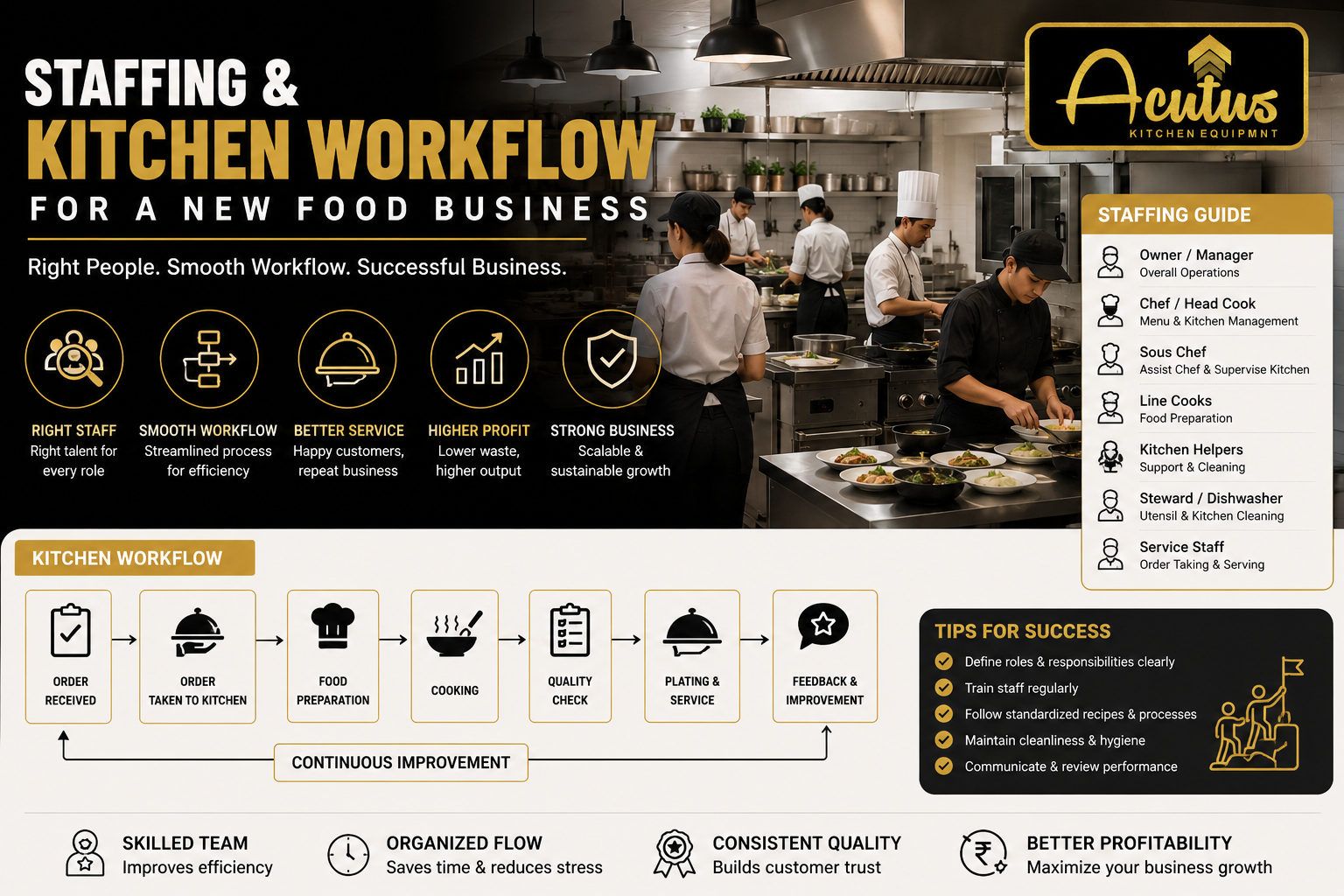
Right people, smooth workflow, successful business. Define clear kitchen roles from owner down to service staff, map your order-to-service workflow so every step flows in one direction, and back it with standardised recipes and regular training. Kitchens that skip this structure compensate with extra staff or longer hours instead of fixing the root cause.
Good equipment and a solid menu can still underperform if the kitchen behind them isn't staffed and organised properly. Most new food businesses either understaff (leading to burnout and slow service) or overstaff (eating into margins), largely because roles and workflow were never mapped out clearly before opening.
This guide covers the core roles a new kitchen typically needs, a standard order-to-service workflow you can adapt, and the habits that keep quality consistent as you scale.
Why Staffing & Workflow Matter
The right staff on a smooth workflow directly translates into better service, higher profit, and a business that can scale without breaking. Undefined roles create confusion during rush hours; an unmapped workflow creates bottlenecks that slow down every order, not just the difficult ones.
The Core Kitchen Staffing Roles
| Role | Responsibility |
|---|---|
| Owner / Manager | Overall operations |
| Chef / Head Cook | Menu & kitchen management |
| Sous Chef | Assist chef & supervise kitchen |
| Line Cooks | Food preparation |
| Kitchen Helpers | Support & cleaning |
| Steward / Dishwasher | Utensil & kitchen cleaning |
| Service Staff | Order taking & serving |
Smaller kitchens often combine roles — an owner may double as head cook, or a line cook may also handle plating. Scale up these roles as order volume justifies dedicated staff for each.
The Kitchen Workflow, Step by Step
Feedback and improvement loop back into the process continuously — every completed order is a chance to spot where the workflow slowed down or where a step can be tightened.
Tips for Success
Frequently Asked Questions
It depends entirely on your scale and menu complexity, but most kitchens need at minimum a chef/head cook, one or more line cooks, a kitchen helper for support, and someone handling service or order coordination. Smaller operations often combine roles rather than hiring separately for each.
A typical flow is: order received, order taken to kitchen, food preparation, cooking, quality check, plating and service, and finally feedback and improvement — which loops back to refine the process continuously. Mapping this clearly prevents bottlenecks during busy periods.
Standardised recipes and clearly defined roles are the biggest accelerators — new staff can follow a documented process instead of learning by trial and error. Regular training sessions and clear communication of expectations also reduce the time it takes someone to become productive.
Yes — a well-organised layout with equipment placed in workflow order reduces the number of steps staff need to take per order, which can reduce staffing needs or increase output with the same team. Poor layout often gets compensated for with extra staff instead of fixed at the source.
Standardised recipes and processes are essential — without them, quality drifts as more people touch the same dish differently. Regular training, clear roles, and a quality-check step in your workflow (before plating) help catch inconsistency before it reaches the customer.
Conclusion
A kitchen with clear roles and a mapped workflow doesn't just run smoother — it scales without needing to reinvent itself every time order volume grows. Define roles early, standardise your process, and build in a feedback step so the workflow keeps improving.
A well-laid-out kitchen, equipped correctly for your workflow, makes all of this easier. Talk to us about equipment that fits your kitchen's layout and order flow.

Written By
Dhaval PrajapatiFounder of Acutus Kitchen Equipment, with 10 years of hands-on experience in commercial kitchen and stainless-steel equipment manufacturing.
Building a Kitchen Layout That Matches Your Workflow?
Get in touch and we'll help you plan equipment placement that supports your team, not slows them down.