Break-Even & ROI Calculationfor Kitchen Equipment Investment
Quick Answer
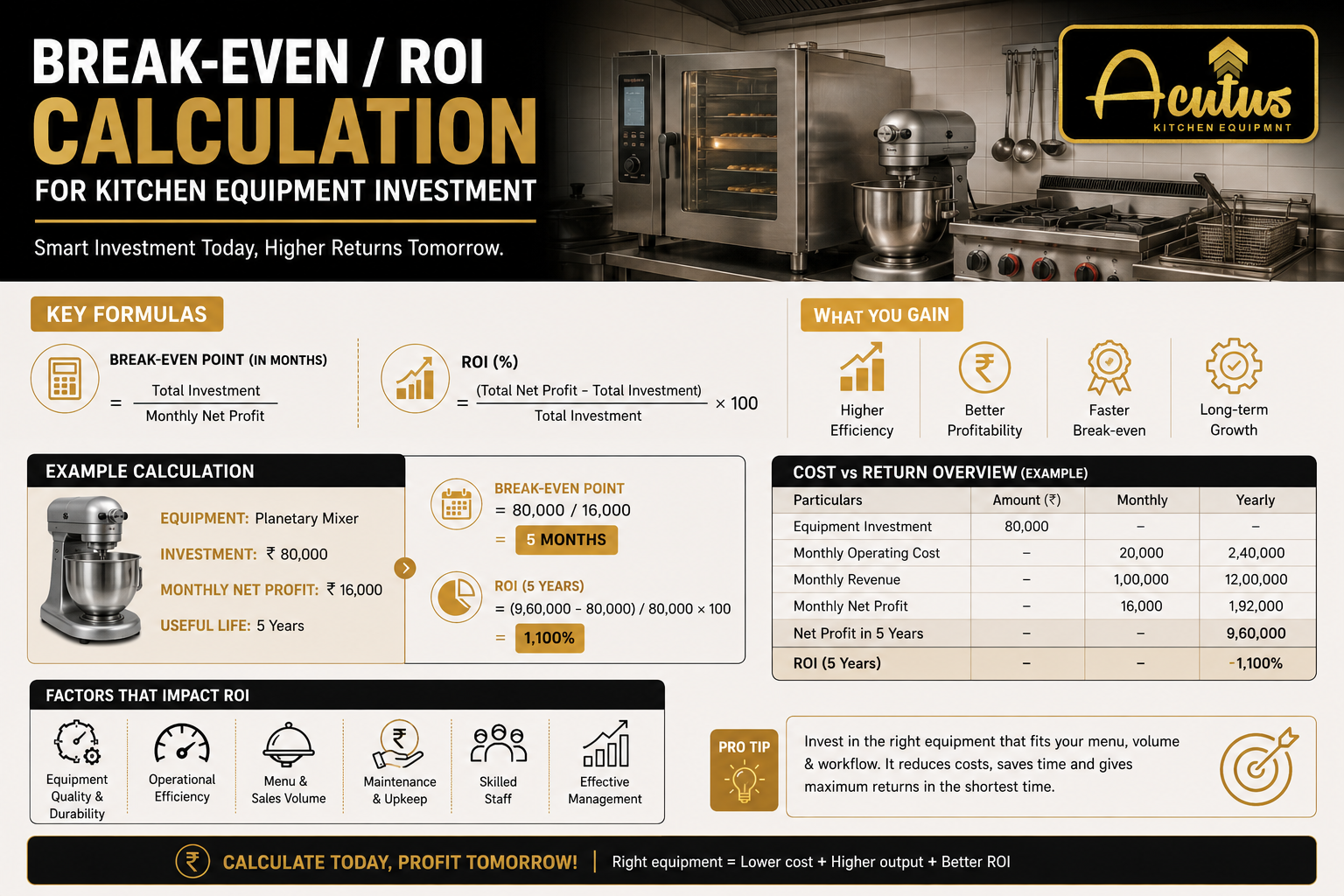
Break-even point (months) = Total Investment ÷ Monthly Net Profit. ROI (%) = (Total Net Profit − Total Investment) ÷ Total Investment × 100. A ₹80,000 machine generating ₹16,000 monthly net profit breaks even in 5 months and can return over 1,000% ROI across a 5-year useful life — but only if the equipment stays reliable enough to keep producing that profit month after month.
Kitchen equipment is often bought on gut feeling — "we need a mixer" — without ever running the numbers on when that purchase actually pays for itself. Break-even and ROI calculations turn that gut feeling into a defensible number you can compare across different equipment options.
This guide walks through the two formulas that matter most, a worked example using a planetary mixer, and the factors that actually determine whether your real-world ROI matches the spreadsheet.
Why ROI Matters for Equipment Purchases
Every piece of equipment competes for the same limited capital. Calculating break-even and ROI lets you compare options on equal footing — a cheaper machine isn't automatically the better investment if it generates less monthly profit or breaks down more often than a pricier, more durable alternative.
The Key Formulas
Break-Even Point (in months)
Total Investment ÷ Monthly Net Profit
ROI (%)
(Total Net Profit − Total Investment) ÷ Total Investment × 100
A Worked Example: Planetary Mixer
Inputs
- Equipment: Planetary Mixer
- Investment: ₹80,000
- Monthly Net Profit: ₹16,000
- Useful Life: 5 Years
Results
Break-Even Point
80,000 ÷ 16,000 = 5 months
ROI (5 Years)
(9,60,000 − 80,000) ÷ 80,000 × 100 = 1,100%
Cost vs Return Overview
| Particulars | Amount (₹) | Monthly | Yearly |
|---|---|---|---|
| Equipment Investment | 80,000 | — | — |
| Monthly Operating Cost | — | 20,000 | 2,40,000 |
| Monthly Revenue | — | 1,00,000 | 12,00,000 |
| Monthly Net Profit | — | 16,000 | 1,92,000 |
| Net Profit in 5 Years | — | — | 9,60,000 |
Illustrative figures based on the planetary mixer example above — swap in your own equipment cost, revenue, and operating cost to calculate your real numbers.
Factors That Impact ROI
Equipment Quality & Durability
Well-built equipment breaks down less, keeping the profit line uninterrupted.
Operational Efficiency
Faster, more consistent output means more units sold per hour of operation.
Maintenance & Upkeep
Regular upkeep prevents costly downtime and extends useful life.
Skilled Staff
Well-trained staff get more consistent output from the same equipment.
The formula assumes consistent monthly net profit — but that consistency depends on the equipment actually staying operational. A machine that breaks down loses you both the repair cost and the profit it would have generated, which is why build quality is part of the ROI calculation, not separate from it.
Frequently Asked Questions
Break-even point (in months) = Total Investment ÷ Monthly Net Profit. For example, equipment costing ₹80,000 with a monthly net profit of ₹16,000 breaks even in 5 months (80,000 ÷ 16,000).
ROI (%) = (Total Net Profit − Total Investment) ÷ Total Investment × 100. Using the same example over the equipment's 5-year useful life: (₹9,60,000 − ₹80,000) ÷ ₹80,000 × 100 = 1,100% ROI.
Net profit is your revenue from that equipment minus the operating costs directly tied to running it — ingredients, utilities, and relevant labour. It should not include the one-time equipment investment itself, which is accounted for separately in the ROI formula.
Cheaper equipment that breaks down often interrupts your monthly net profit — every day of downtime is lost revenue that doesn't show up in the purchase price but directly hurts your break-even timeline and ROI. Durable, well-built equipment protects the profit side of the calculation, not just the cost side.
There's no universal number — it depends on the equipment's useful life and your business model. A shorter break-even (a few months) relative to a multi-year useful life generally signals a strong investment, since the remaining years are almost entirely profit.
Conclusion
Running the break-even and ROI numbers before you buy turns an equipment purchase from a guess into a decision you can defend. Right equipment means lower cost, higher output, and better ROI — but only if it's durable enough to keep generating that monthly profit for its full useful life.
Talk to us about equipment built to protect your ROI, not just your upfront budget.

Written By
Dhaval PrajapatiFounder of Acutus Kitchen Equipment, with 10 years of hands-on experience in commercial kitchen and stainless-steel equipment manufacturing.
Want Equipment That Protects Your ROI?
Built for uptime, not just a lower price tag. Get in touch for pricing and availability.