Commercial Kitchen AutomationTrends in India
Quick Answer
Commercial kitchens in India are increasingly adopting smart ovens, IoT-connected equipment, real-time monitoring dashboards, and auto-optimization features — reducing manual checks and catching issues faster. Adoption doesn't require a full renovation; most kitchens start with one high-impact piece of automated equipment and expand from there.
Commercial kitchens have traditionally relied on staff to monitor temperature, timing, and equipment status manually. That's changing — smart, connected equipment is becoming more common across Indian commercial kitchens, from independent outlets to larger chains, as operators look for ways to reduce waste, save energy, and catch problems before they become costly.
This piece looks at the automation trends actually showing up in commercial kitchens today, and what adopting them looks like in practice — without needing to replace an entire kitchen at once.
Why Kitchen Automation Is Growing in India
Rising labour costs, growing order volumes from delivery platforms, and increasing pressure on margins are pushing kitchen operators to look for ways to do more with the same team. Automated equipment addresses this directly — reducing the manual monitoring burden so staff time goes toward food quality and service instead of watching a temperature dial.
Four Trends Shaping Commercial Kitchens
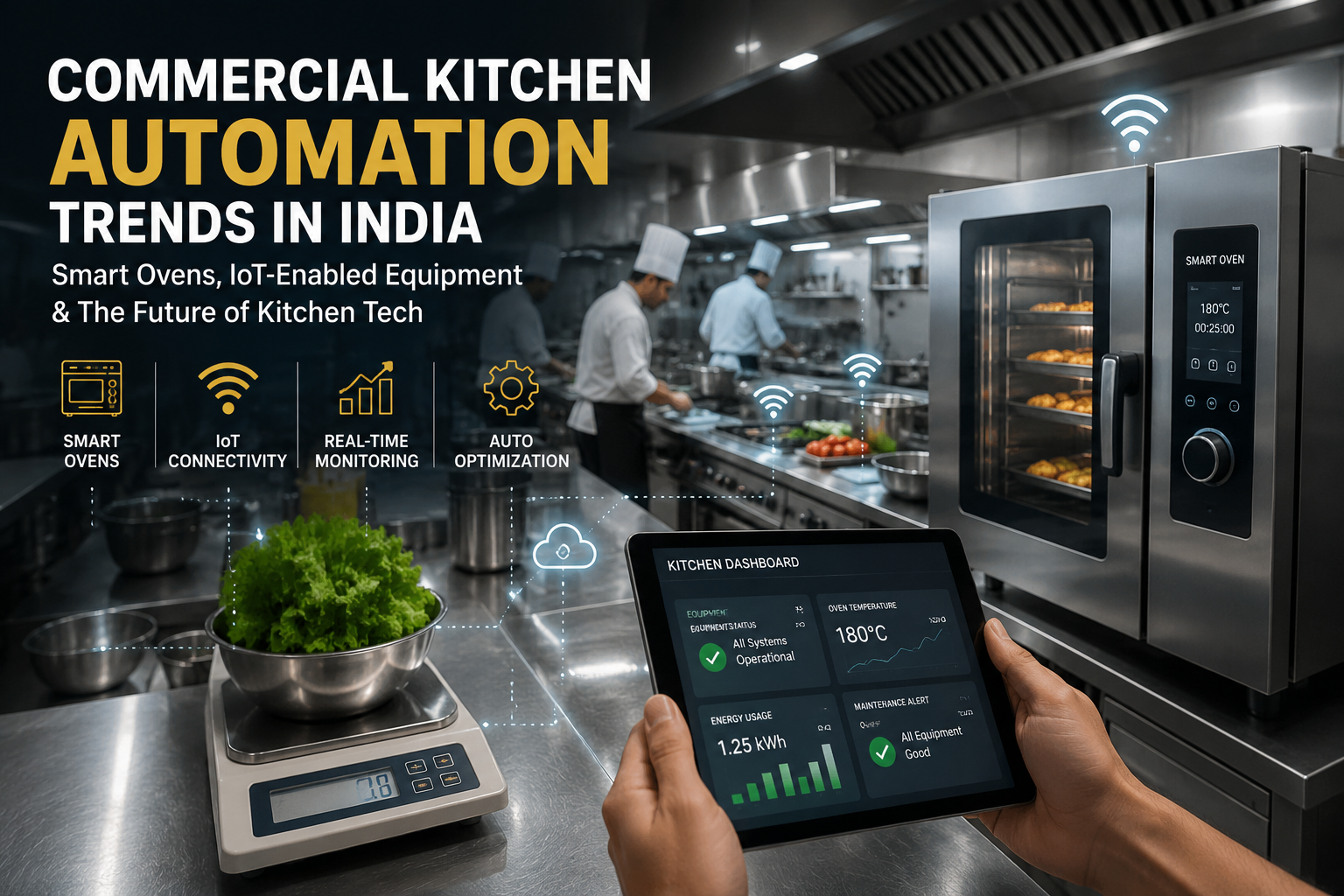
Smart Ovens
Programmable temperature and timing, reducing dependence on manual monitoring for consistent results.
IoT Connectivity
Equipment connected to a central dashboard, giving operators visibility across every machine at once.
Real-Time Monitoring
Live tracking of temperature, energy usage, and equipment status, instead of periodic manual checks.
Auto Optimization
Equipment that adjusts settings automatically based on load and usage patterns to save energy.
Real-World Benefits for Kitchen Operators
A kitchen dashboard showing "all equipment operational," live oven temperature, and energy usage in real time turns equipment monitoring from a physical walkthrough into a glance at a screen. Maintenance alerts flag issues before they cause a breakdown mid-service — catching a problem early is far cheaper than an emergency repair during peak hours.
Energy tracking also matters more than it might seem — knowing exactly how much power each piece of equipment draws lets operators identify inefficient machines and justify upgrades with real numbers instead of guesswork.
Faster Issue Detection
Maintenance alerts catch problems before they cause downtime.
Data-Backed Decisions
Real energy and usage data replaces guesswork on upgrades.
Getting Started Without Overhauling Everything
Full automation isn't a day-one requirement. Most kitchens adopt it incrementally — starting with the equipment used most heavily (an oven, a fryer) and evaluating the real-world benefit before committing to more. This keeps capital risk low while still capturing the biggest wins first.
Whatever your automation roadmap looks like, it still starts with well-built base equipment — automation features are only as reliable as the machine they're built into. Explore Acutus's product range for equipment built to support your kitchen's next stage.
Frequently Asked Questions
It refers to equipment and systems that reduce manual monitoring and intervention — smart ovens with programmable settings, IoT-connected equipment reporting status to a central dashboard, and systems that auto-adjust based on usage patterns, rather than requiring staff to check and adjust manually.
Automation is increasingly accessible at smaller scales too — individual smart appliances (a programmable oven, a connected fryer) can be adopted independently without a full kitchen overhaul, making it practical for single-outlet businesses, not just large chains.
It changes the nature of the work more than it eliminates it — automation handles repetitive monitoring tasks (temperature checks, timing), freeing staff to focus on food quality, plating, and service. Skilled staff are still essential for judgment calls automation can't make.
Centralised visibility — instead of physically checking each machine, operators can see equipment status, temperature, and energy usage from one dashboard. This catches issues (like a maintenance alert) faster than a manual walkthrough would.
Start with one high-impact piece of equipment — a smart oven or a connected fryer — rather than replacing an entire kitchen at once. This lets you evaluate the real-world benefit before committing capital to a full automated setup.
Conclusion
Kitchen automation in India is moving from a large-chain feature to something accessible for kitchens of every size — driven by real operational pressure, not just novelty. Start with one piece of equipment, measure the real benefit, and expand from there.
Talk to us about equipment built to support smart, connected kitchen operations.

Written By
Dhaval PrajapatiFounder of Acutus Kitchen Equipment, with 10 years of hands-on experience in commercial kitchen and stainless-steel equipment manufacturing.
Planning Your Kitchen's Next Upgrade?
Get in touch for pricing and availability on equipment built for modern commercial kitchens.