Menu Planning to Equipment BudgetA Step-by-Step Guide
Quick Answer
Your equipment budget should come from your menu, not the other way around. Finalise your menu, map each dish to the equipment it needs, price everything realistically including installation, and total it against your available capital. This turns a vague "how much will equipment cost" question into an itemised, defensible number.
Most first-time equipment budgets go wrong the same way — they start from a generic equipment list instead of the actual menu. The result is either missing equipment for dishes added later, or money spent on machines the kitchen never really needed.
This guide walks through a simple, repeatable process for turning your menu into a realistic equipment budget — with a worked example you can adapt to your own numbers.
Why Your Menu Should Drive Equipment Choices
Every dish on your menu implies specific equipment — a grill menu item needs a grill, a fried item needs a fryer, a baked item needs an oven. Working backward from a generic "kitchen equipment list" instead of your actual menu is how kitchens end up with machines they rarely use, while missing something they need every single day.
The 4-Step Budgeting Process
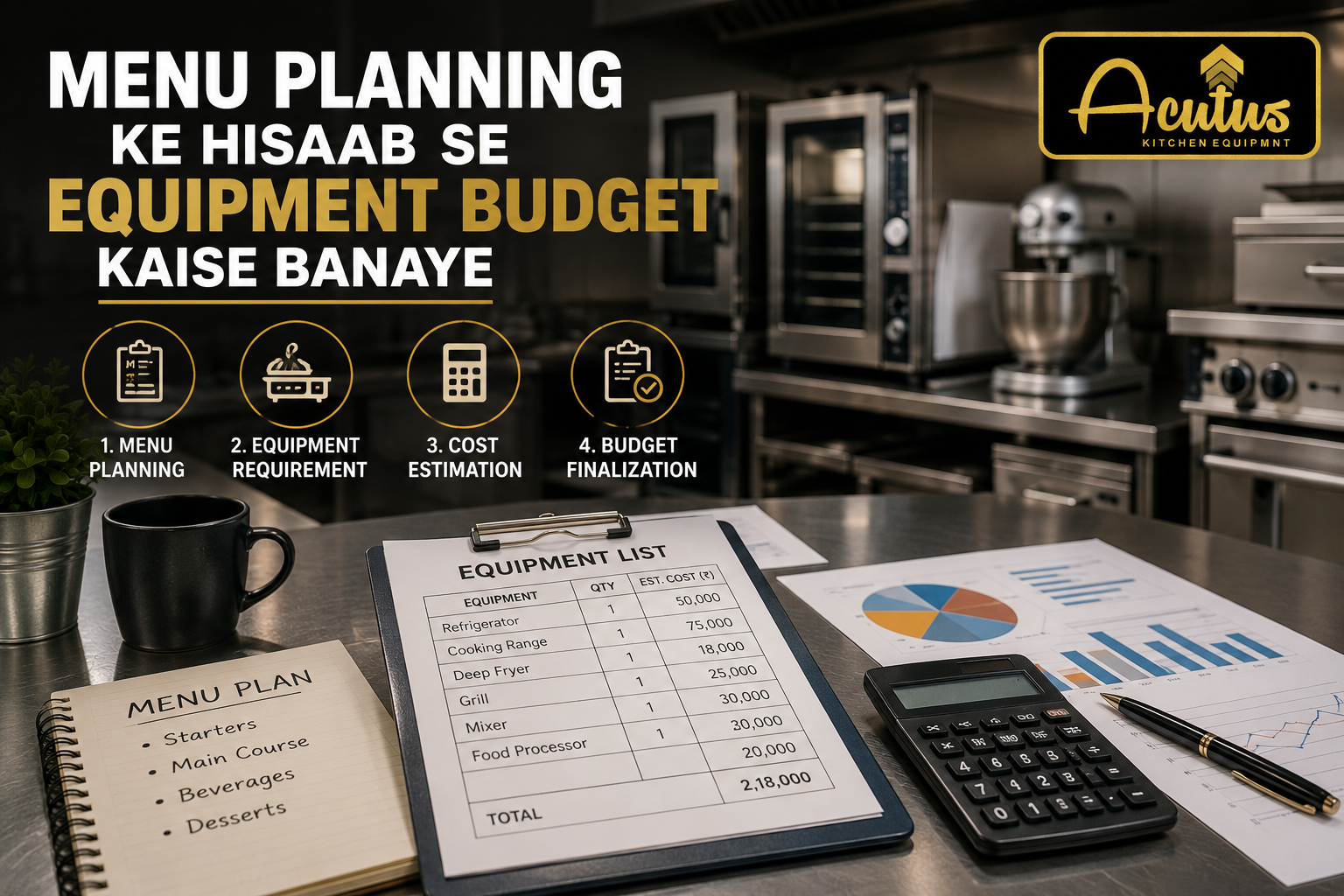
Menu Planning
Finalise your core menu first — every equipment decision downstream depends on what you're actually cooking.
Equipment Requirement
Map each dish to the equipment it needs, and note shared equipment across multiple dishes.
Cost Estimation
Price each item realistically, including installation and any accessories you'll actually need on day one.
Budget Finalization
Total it up, compare against your available capital, and adjust menu or equipment choices to fit.
A Sample Equipment Budget
Here's a worked example for a small commercial kitchen menu — use it as a template and swap in your own equipment and prices:
| Equipment | Qty | Est. Cost (₹) |
|---|---|---|
| Refrigerator | 1 | 50,000 |
| Cooking Range | 1 | 75,000 |
| Deep Fryer | 1 | 18,000 |
| Grill | 1 | 30,000 |
| Mixer | 1 | 30,000 |
| Food Processor | 1 | 20,000 |
| Total | 2,23,000 | |
Illustrative figures only — actual costs vary by equipment specification, brand, and city. Explore Acutus's product range for current pricing on your specific equipment list.
Cost-Saving Tips Without Cutting Corners
Design a Shared-Equipment Menu
Favour dishes that share equipment over ones needing single-purpose machines.
Get an All-In Quote
Ask for installation and accessories included, not just the machine price.
Prioritise Heavily-Used Equipment
Spend more on machines you'll run daily; save on occasional-use items.
Buy for Real Volume
Size equipment to expected daily orders, not your busiest imaginable day.
Frequently Asked Questions
Start with your menu — list every dish, identify the equipment each one requires, and price each piece realistically including installation. This gives you an itemised total instead of a rough guess, and it's easy to see where the budget can flex if needed.
Not necessarily. Cheaper equipment often means lower build quality, which leads to more breakdowns and shorter working life — costing more over time than a slightly higher upfront investment in properly built equipment. Budget by prioritising equipment used most heavily, not by defaulting to the lowest price everywhere.
Buying equipment before finalising the menu. This leads to either under-buying (missing equipment for dishes you later add) or over-buying (equipment for dishes that never made the final menu). Menu first, equipment second, always.
Yes — a single combi oven can often replace separate baking and roasting equipment, and a good mixer can cover multiple prep tasks. Look for equipment that serves several menu items instead of buying single-purpose machines for everything.
Yes — installation, gas/electrical connections, and essential accessories (trays, attachments, initial spare parts) are often left out of budgets and then show up as surprise costs. Ask your equipment supplier for an all-in quote rather than just the machine price.
Conclusion
An equipment budget built from your actual menu is always more accurate — and more defensible to investors or lenders — than one based on a generic checklist. Finalise the menu first, map equipment to dishes, price it realistically, and you'll have a number you can actually plan around.
Share your menu with us and we'll help you build an itemised equipment budget matched to it.

Written By
Dhaval PrajapatiFounder of Acutus Kitchen Equipment, with 10 years of hands-on experience in commercial kitchen and stainless-steel equipment manufacturing.
Want an Equipment Quote Matched to Your Menu?
Share your menu and we'll put together an itemised equipment budget — no over-buying, no guesswork.