How to Start a Cloud KitchenCost & Equipment Checklist
Quick Answer
A cloud kitchen needs less upfront investment than a full restaurant because you skip dine-in space and front-of-house staff — but the kitchen equipment itself has to match your menu exactly. Budget across six buckets: rent, equipment, staff, packaging, marketing, and miscellaneous overheads, with equipment usually being your largest one-time cost.
Cloud kitchens have become one of the lowest-barrier ways to start a food business in India — no dine-in space, no front-of-house staff, and a menu built entirely around delivery. But "low barrier" doesn't mean "low planning." The kitchen still has to be equipped correctly for your menu, and the cost structure still needs to be mapped out before you sign a lease.
This guide walks through what a cloud kitchen actually needs — equipment-wise and cost-wise — so you can plan a launch budget that's realistic instead of guessed.
What Is a Cloud Kitchen?
A cloud kitchen (also called a ghost kitchen or delivery-only kitchen) is a commercial kitchen built exclusively to prepare food for delivery — there's no dining area, no seating, and no walk-in customers. Orders come through delivery apps or a direct ordering system, and the entire layout is optimised for cooking speed and order turnaround, not customer experience.
Why a Cloud Kitchen Model Works
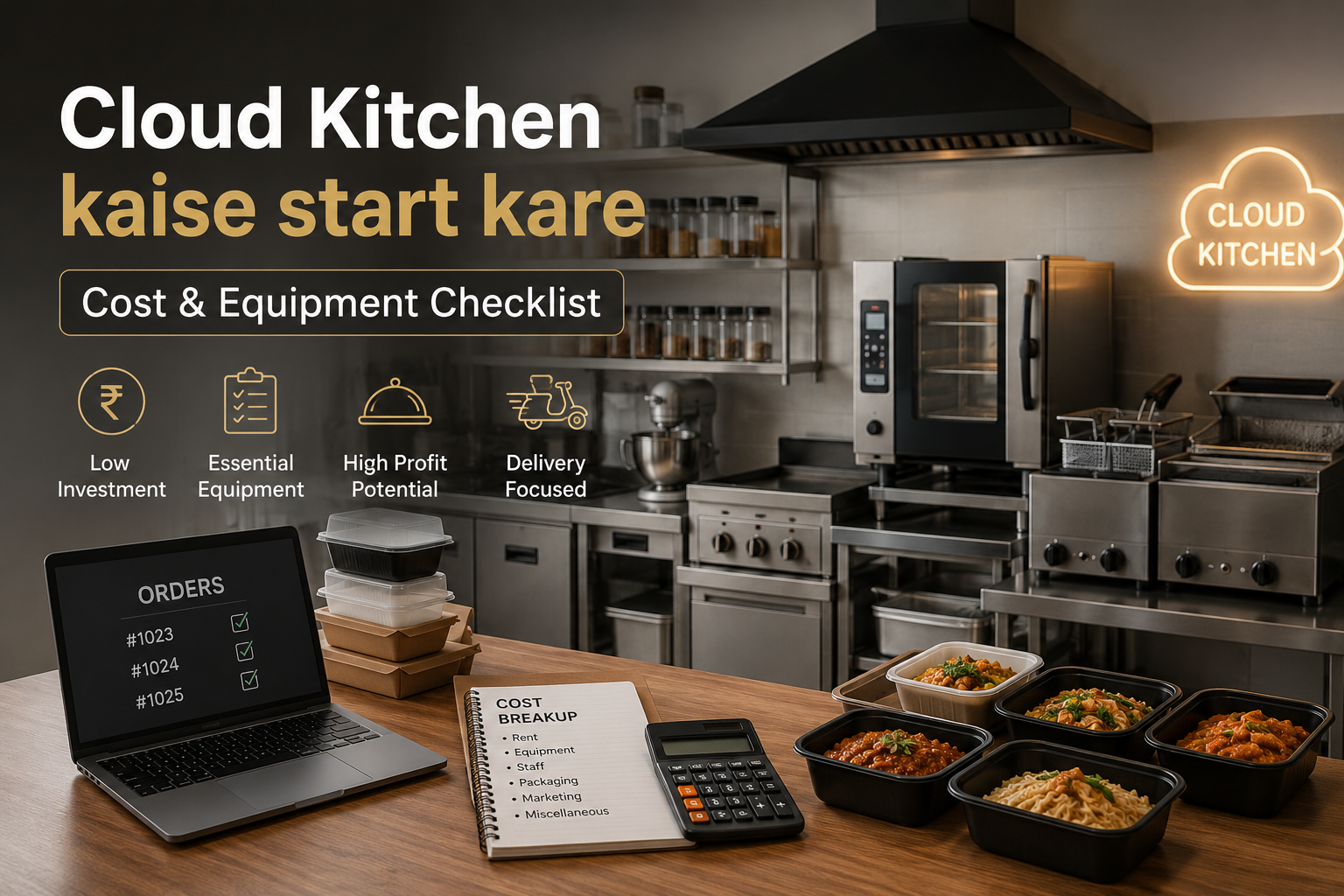
Low Investment
No dine-in fit-out, furniture, or front-of-house staff to fund.
Essential Equipment Only
You equip for cooking and packing — nothing for dining.
High Profit Potential
Lower fixed costs mean more of each order's revenue reaches margin.
Delivery Focused
Every part of the workflow is built around order-to-delivery speed.
Essential Equipment Checklist
Your exact list depends on your menu, but these cover most delivery-first kitchens:
| Equipment | Why You Need It |
|---|---|
| Commercial Cooking Range / Burner | The core of most menus — needs to handle continuous, high-volume cooking. |
| Deep Fryer | Essential for fried snacks and starters, a staple across most delivery menus. |
| Combi / Baking Oven | Covers baking, roasting, and reheating in one unit — space-efficient for a compact kitchen. |
| Planetary or Spiral Mixer | Needed if your menu includes bakery items, batters, or dough in any volume. |
| Refrigeration & Storage | Keeps raw material fresh and safe — non-negotiable for food safety compliance. |
| Packaging Station & Supplies | Delivery-first businesses live or die by packaging speed and food-safe containers. |
Explore Acutus's cooking equipment, bakery equipment, and full product range to build a cloud kitchen equipment list matched to your menu.
Cost Breakdown: Where the Money Goes
Rent
Cloud kitchens don't need dine-in space, so this is usually lower than a full restaurant.
Equipment
Your single largest one-time investment — sized to your menu, not guessed.
Staff
Kitchen staff and delivery coordination, scaled to order volume.
Packaging
Ongoing cost per order — food-safe containers, bags, and sealing.
Marketing
Delivery-app visibility and any direct-to-customer promotion.
Miscellaneous
Utilities, licensing renewals, and day-to-day operational costs.
Setting Up Your Cloud Kitchen Workflow
Start from your menu, not a generic equipment list. Map every dish to the equipment it needs, size that equipment to your expected daily order volume (not your best-case guess), and lay out the kitchen so that order-taking, cooking, and packaging flow in one direction without staff crossing paths.
Launch with a focused menu that fits your core equipment, then expand as real order data tells you where demand is — rather than buying for a menu you haven't validated yet.
Frequently Asked Questions
It varies widely by city and menu, but the core cost buckets are consistent: rent, equipment, staff, packaging, marketing, and miscellaneous overheads. Equipment is usually the largest one-time cost, so sizing it correctly to your actual menu — not over-buying — is the biggest lever on your starting budget.
At minimum: a commercial cooking range, a deep fryer if you're serving fried items, an oven if baking or roasting is on the menu, a mixer if you're making batters or dough, proper refrigeration, and a dedicated packaging station. Beyond that, it depends entirely on what's on your menu.
Generally yes — you skip dine-in space, furniture, and front-of-house staff, which lowers rent and staffing costs significantly. Equipment cost stays similar to a restaurant kitchen of the same menu size, since the cooking demand doesn't change just because there's no dining room.
Start from your menu, not a generic equipment list. List every dish, note what equipment each one needs, and buy for your actual production volume — not the busiest day you can imagine. This avoids both underbuying (bottlenecks) and overbuying (wasted capital).
Yes, if your menu is designed for it — launch with a focused menu covering your core equipment, then expand the menu (and add equipment) as order volume justifies it. This spreads out capital investment instead of front-loading everything before you have real order data.
Conclusion
A cloud kitchen's lower barrier to entry is real, but it only pays off if the kitchen is equipped correctly from day one. Undersized equipment creates bottlenecks the moment orders pick up; oversized equipment ties up capital you didn't need to spend.
Map your menu, size your equipment to match, and budget across all six cost buckets before you commit to a lease. Talk to us about building an equipment list for your specific menu.

Written By
Dhaval PrajapatiFounder of Acutus Kitchen Equipment, with 10 years of hands-on experience in commercial kitchen and stainless-steel equipment manufacturing.
Planning Your Cloud Kitchen Equipment List?
Tell us your menu and we'll help you size the right equipment — no over-buying, no bottlenecks.