Franchise vs Independent OutletEquipment Consideration
Quick Answer
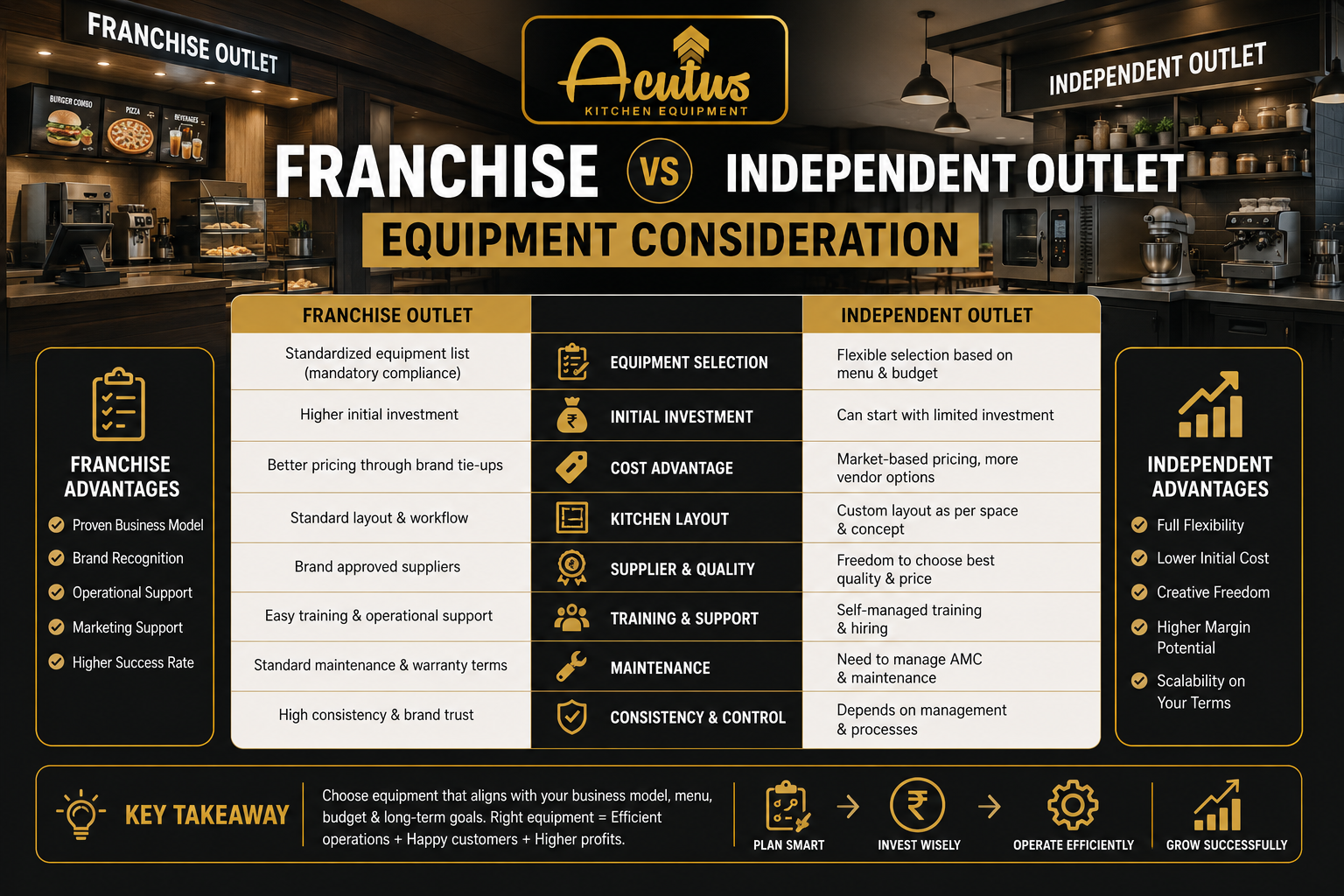
Choose equipment that aligns with your business model, menu, budget, and long-term goals. A franchise gives you a standardized equipment list, brand-approved suppliers, and operational support — at a higher initial investment. An independent outlet gives you full flexibility and lower starting cost, but you manage supplier selection, training, and maintenance entirely yourself.
Deciding between a franchise and an independent outlet is often framed as a branding or business-model question — but it has a very real equipment dimension too. Franchise agreements often dictate exactly what equipment you can buy and from whom; independent outlets leave every one of those decisions to you.
This guide compares the two paths specifically on equipment selection, investment, layout, and ongoing maintenance, so you know what you're signing up for either way.
The Real Difference Isn't Just the Brand
Most people evaluate franchise vs independent purely on brand recognition and fees. But operationally, the equipment decisions differ just as much — a franchise standardises your equipment list, layout, and suppliers to protect brand consistency across every outlet, while an independent outlet leaves all of that flexible, for better or worse.
Franchise vs Independent Outlet: Feature-by-Feature
| Attribute | Franchise Outlet | Independent Outlet |
|---|---|---|
| Equipment Selection | Standardized equipment list (mandatory compliance) | Flexible selection based on menu & budget |
| Initial Investment | Higher initial investment | Can start with limited investment |
| Cost Advantage | Better pricing through brand tie-ups | Market-based pricing, more vendor options |
| Kitchen Layout | Standard layout & workflow | Custom layout as per space & concept |
| Supplier & Quality | Brand-approved suppliers | Freedom to choose best quality & price |
| Training & Support | Easy training & operational support | Self-managed training & hiring |
| Maintenance | Standard maintenance & warranty terms | Need to manage AMC & maintenance |
| Consistency & Control | High consistency & brand trust | Depends on management & processes |
Franchise Advantages
Independent Outlet Advantages
Which One Should You Choose?
Franchise is often the safer starting point if you want a proven model, brand recognition, and operational support — worth the higher initial investment and reduced equipment flexibility. Independent is the better fit if you want full creative control over your menu, layout, and equipment, and you're prepared to manage supplier relationships and maintenance yourself.
Either way, choose equipment that aligns with your actual business model, menu, and budget — the right equipment means efficient operations, happier customers, and higher profits, regardless of which path you take.
Frequently Asked Questions
An independent outlet can often start with a lower initial investment since you're not bound to a brand's standardised equipment list or approved-supplier pricing. A franchise typically requires higher upfront investment but comes with operational support and a proven business model in exchange.
Most franchise agreements specify a standardised equipment list and often mandate brand-approved suppliers, to maintain consistency across all outlets. This limits your choice but also simplifies compliance and often secures better tie-up pricing than you'd get independently.
Generally no — franchises typically require a standard layout and workflow so operations stay consistent across every outlet. An independent outlet gives you full freedom to design a layout matched to your specific space and concept.
Independent outlets typically offer higher margin potential since you're not paying franchise fees or royalties, but this comes with more operational risk and no built-in brand support. Franchises trade some margin for a proven model and higher statistical success rate.
Franchises usually come with standard maintenance and warranty terms defined by the brand agreement. Independent outlet owners manage their own AMC (annual maintenance contracts) and equipment servicing directly with their supplier — more control, but more responsibility.
Conclusion
Franchise vs independent isn't just a branding decision — it shapes every equipment choice you'll make, from supplier freedom to kitchen layout to who handles maintenance. Know which trade-offs you're comfortable with before you commit.
Whichever path you choose, we can help you plan equipment that fits your model, budget, and space.

Written By
Dhaval PrajapatiFounder of Acutus Kitchen Equipment, with 10 years of hands-on experience in commercial kitchen and stainless-steel equipment manufacturing.
Planning Equipment for a Franchise or Independent Outlet?
We work with both — standardized franchise equipment lists and fully custom independent kitchen builds.